The short answer: Thermoforming tends to be the better fit for large-format parts, low-to-mid production volumes, and projects where speed to first article matters. Injection molding earns its place when volumes are extremely high and parts are small with tight geometric detail. Read on to see how each factor plays out in practice.
What’s the Difference Between Thermoforming and Injection Molding?
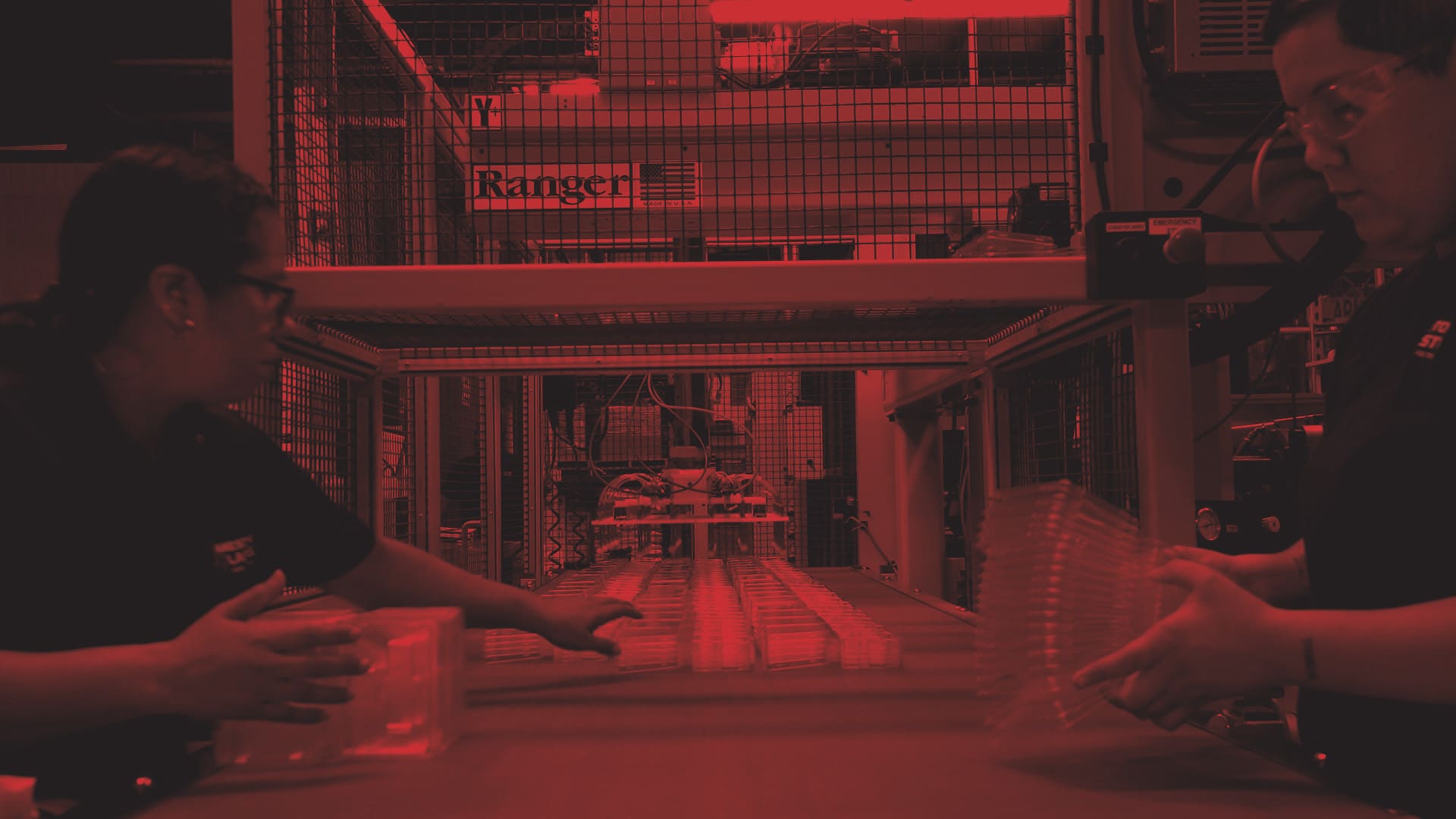
Thermoforming heats plastic sheet until it’s pliable, then uses vacuum and/or air pressure to pull or push it over a mold. Once cooled, the part may then be trimmed to its final shape. It’s a relatively straightforward process that works across a wide range of materials and part sizes.
Injection molding melts plastic pellets and injects the liquefied material into a closed mold cavity under high pressure. The mold opens once the part has cooled and solidified. This process excels at producing large quantities of small, highly detailed parts with tight tolerances, but the tooling required to get there is a significant upfront investment.
Which Process Costs Less to Get Started?
Thermoforming tooling costs considerably less than injection molds. An injection mold for an automotive component can run anywhere from tens of thousands to hundreds of thousands of dollars, depending on part complexity. Thermoforming tooling for a comparable part is a fraction of that—and revisions are far less painful.
This matters more than it might seem. Automotive projects rarely go from concept to final design without at least a few changes along the way. When a design shifts mid-project, modifying a thermoform tool is a manageable task. Reworking an injection mold is expensive and time-consuming, and sometimes the answer is cutting a new one entirely.
What Does a Design Change Look Like in Practice?
Say a hood liner needs a mounting point adjusted after a fitment test. In thermoforming, that’s a relatively minor tooling modification, often handled in days. In injection molding, the same change could require re-machining a steel mold at a significant cost and delay. Automotive teams still validating designs feel the difference in flexibility immediately.
At Jamestown Plastics, all tooling is handled in-house. No outside vendors, no handoffs, no waiting on a third party to slot your revision into their queue: the engineering team that designed the tool is the same team making the change.
How Does Production Volume Affect the Decision?
This is where the math gets straightforward. Injection molding’s high upfront tooling cost makes the most sense when it’s spread across millions of parts. At such a scale, the per-unit cost drops significantly and the investment pays off.
Thermoforming is highly competitive at lower-to-mid volumes, which describes a meaningful portion of automotive work. Interior trim components, specialty panels, wind deflectors, dunnage trays, returnable tote systems—these parts often don’t run at the volumes that justify injection molding’s tooling cost. Thermoforming delivers quality and consistency at the volumes automotive suppliers need for those applications.
It’s also worth noting that many automotive programs use both processes for different components. Thermoforming handles the large-format and lower-volume pieces; injection molding covers the small, high-volume hardware. Choosing one doesn’t mean ruling out the other.
Which Process Gets You to First Article Faster?
Thermoforming tooling can be ready in weeks. Injection molds typically take months. For automotive teams working against a launch schedule or trying to get prototype parts in hand for fitment and validation, a gap like that is significant.
Speed doesn’t mean shortcuts. Jamestown Plastics has held ISO 9001:2015 certification since 2004, with ISO 13485:2016 certification achieved at the New York and Texas locations in 2024. The same quality standards that govern medical device packaging apply here.
The other factor is what happens when timelines get tight. Jamestown Plastics operates across three U.S. locations: Brocton, NY; Meadville, PA; and Brownsville, TX. When capacity at one facility is constrained, the others provide options. Most single-plant operations can’t say the same, and in automotive, where downstream schedules are unforgiving, it matters.
What About Part Size, Geometry, and Materials?
Thermoforming handles large-format parts—up to 5′ x 9’—that would be impractical or cost-prohibitive in injection molding. Automotive applications where this shows up include hood liners, trunk liners, interior trim panels, wind deflectors, bumper guards, and dunnage trays. These are parts where size, not geometric intricacy, is the primary design driver.
Thermoforming can also be the right choice for smaller trim components and appliques, where multiple material or color options are needed to match automotive interiors and exteriors.
Injection molding may be the right call for other small parts requiring very tight tolerances and high surface detail; think fasteners, clips, or precision housings produced at massive scale.
Material flexibility is another area where thermoforming holds its own. At Jamestown Plastics, that includes TPO, ABS, HDPE, RPET, polycarbonate, and a range of specialty materials, including conductive and anti-static options for ESD-sensitive applications. Material gauges run from .005″ to .5″+, covering both light and heavy gauge needs within the same facility.
So, Which Process Is Right for Your Automotive Project?
Here’s a practical way to think through it. Thermoforming is likely the better fit if the parts are large-format, if volumes are low-to-mid, if the design is still being refined, or if time-to-first-article is a priority. The lower tooling investment also makes it easier to run a prototype that’s production-representative, which is exactly how Jamestown Plastics approaches it. Prototype tooling is built with the same materials and techniques used in production, so what customers test is what they get.
Injection molding could make more sense when volumes are very high, parts are small with tight tolerances, and the design is locked in. At those parameters, the tooling investment may amortize well, and the process delivers.
The teams who get this decision right tend to make it early, before tooling dollars are committed. That’s a conversation worth having before the project kicks off, not after the first quote comes back.
FAQ
Is thermoforming or injection molding better for automotive trim components? For most automotive trim–hood liners, interior panels, wind deflectors, bumper guards–thermoforming is typically the better fit. These parts are large-format and run at volumes where thermoforming’s lower tooling cost and faster lead times give it a clear advantage over injection molding.
At what production volume does injection molding become more cost-effective? There’s no universal threshold, but injection molding generally becomes cost-competitive when volumes reach into the hundreds of thousands or millions of identical parts. Below that range, thermoforming’s lower tooling investment usually results in a better total cost of ownership.
How long does thermoforming tooling take compared to injection molding tooling? Thermoforming tools can often be ready in four to six weeks. Injection molds for automotive applications typically take three to six months, sometimes longer for high-complexity parts. When launch timelines are tight, this difference can determine which process is viable.
Can thermoformed parts meet automotive quality and durability standards? Yes. Thermoformed parts are used throughout the automotive industry — in OEM production, Tier 1 and Tier 2 supply chains, and aftermarket applications — and can be produced to meet rigorous quality, dimensional, and material performance requirements. At Jamestown Plastics, all production is backed by an ISO 9001:2015-certified Quality Management System.
The Right Process Starts with the Right Conversation
Jamestown Plastics has been solving manufacturing challenges since 1958, and the thermoforming vs. injection molding question is one the team navigates with customers regularly. With in-house design, tooling, and manufacturing across three U.S. locations, Jamestown Plastics brings the kind of hands-on perspective that turns a process decision into a real project plan.
Ready to talk through your next automotive project? Contact Jamestown Plastics today.