
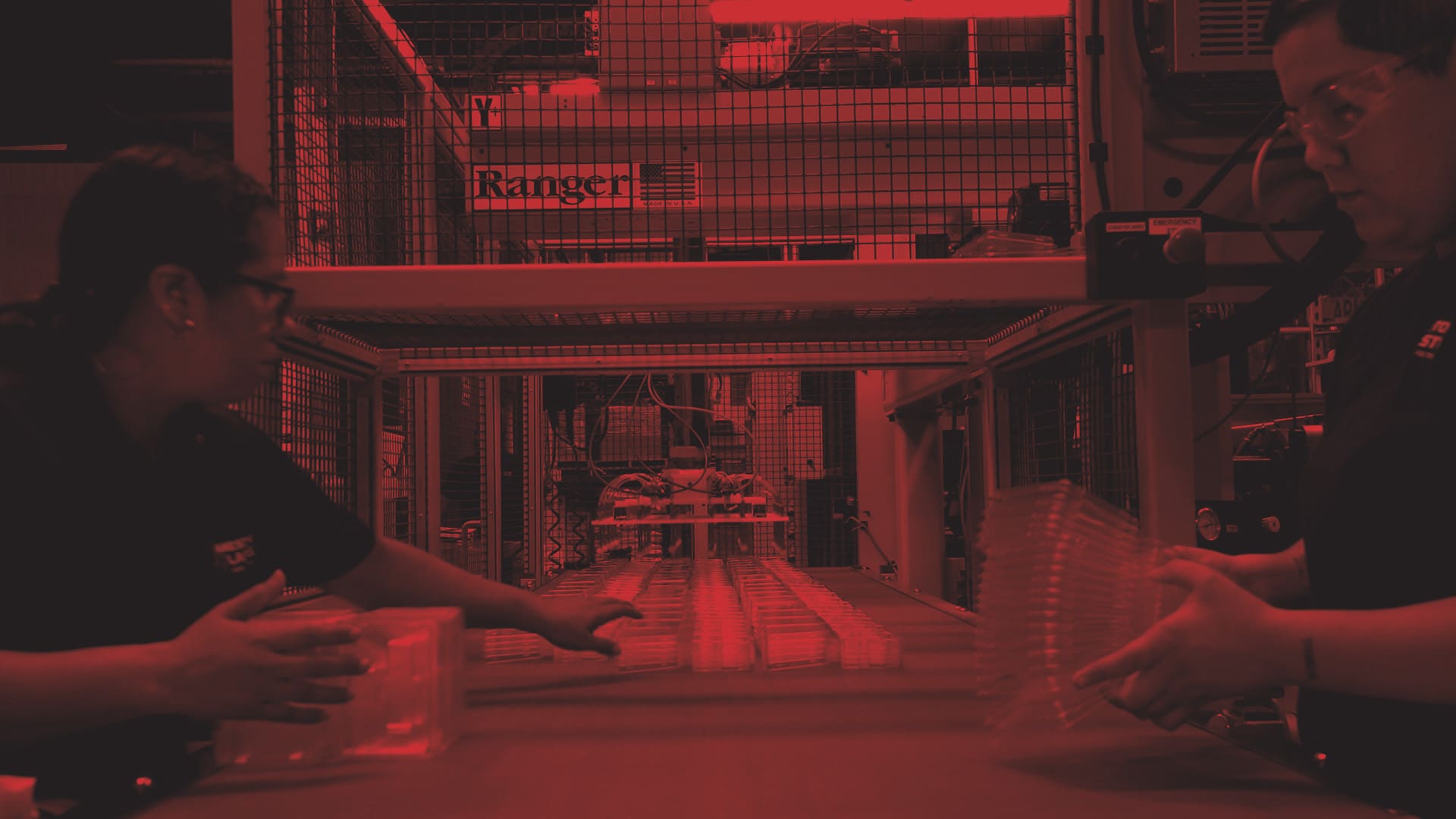
At Jamestown Plastics, we design custom medical procedure trays with this kind of practical order in mind, thinking about how cavity shape, material choice, part orientation, nesting, and pack-out affect how a kit is assembled, checked, stored, shipped, and presented before use. With more than 30 years of medical thermoforming experience, ISO Class 7 and 8 Clean Rooms, in-house design and tooling, and more, our services help customers move from early tray concepts to production-ready packaging with fewer handoffs.
What Are Custom Medical Procedure Trays?
Custom medical procedure trays are thermoformed trays designed around the size, shape, orientation, and handling needs of medical devices, instruments, implants, or kit components. Instead of fitting a product into a standard tray, we build the tray around the product.
A custom tray can separate components, reduce movement, support visual inspection, and protect delicate features during handling, storage, and transport. Surgical kit packaging may use trays for orthopedic implants, diagnostic components, instruments, unit-dose products, or accessory sets.
Each medical packaging project brings different priorities. Some trays need clear material for inspection. Others need rigidity, part separation, or a specific geometry to support loading and removal. We look at how the tray needs to function in the full packaging process, not only how it looks as a formed part.
How Do Procedure Trays Support Sterile Surgical Kit Packaging?
Sterile surgical kit packaging depends on a complete system. The tray, lid, barrier materials, sealing process, sterilization method, labeling, and pack-out workflow all need to work together. Procedure trays play a practical role because they organize the kit and help protect components before use. Components can be organized by sequence, size, sensitivity, or use case. Cavities, ribs, contours, and dividers can limit movement and reduce contact between parts. Clear layouts can also help pack-out teams verify kit contents before the package moves to the next step.
Sterile kit design requirements vary by device, customer specification, sterilization method, and packaging system. Early tray design conversations make it easier to account for those needs before tooling, production, and pack-out decisions are locked in.
What Are the Requirements for Surgical Kit Tray Design?
Surgical kit tray design starts with the device or component being packaged. Each cavity should hold the product securely without placing pressure on sensitive areas. Small details in the tray geometry can influence how a component fits, how easily it can be loaded, and how well it stays in position during handling.
Protection is also central to the design. Medical instrument protectors and device trays may need clearance around tips, edges, connectors, coatings, or fragile features. Orthopedic implant trays may need to account for multiple sizes or related components within the same kit.
Usability matters throughout the process. A tray should work for the people loading, checking, sealing, opening, and using it. Features such as finger access, part orientation, nesting, stacking, labeling space, and pack-out efficiency can all affect the final design.
Material selection belongs in the same early conversation. Some applications call for clarity to support inspection, while others require impact resistance, rigidity, chemical resistance, or specific forming properties. A tray designed around the right material from the start is easier to carry through production.
Why Does ISO 13485:2016 Matter for Medical Packaging Projects?
Medical packaging projects require strong process control. Documentation, traceability, inspection, and consistent production practices all matter when the finished package supports a medical device or healthcare product.
Jamestown Plastics is ISO 9001:2015 certified and has achieved ISO 13485:2016 certification at our New York and Texas locations. ISO 13485:2016 is an important trust signal for medical OEMs because it reflects a quality management system aligned with medical device manufacturing expectations.
Certification doesn’t replace product-specific validation or customer-defined requirements, but it does show our team understands the discipline needed for medical packaging work, including controlled processes, documented procedures, and quality-focused production. In custom sterile packaging design, surgical kit packaging, and medical device trays, those systems help create confidence from the start of the program.
What Materials Work Best for Medical Procedure Trays?
The best material for a medical procedure tray depends on the product, packaging process, performance needs, and customer goals. A delicate diagnostic component may need a different balance of clarity and rigidity than a heavier instrument or implant.
Jamestown Plastics offers a wide range of material options for light-gauge and heavy-gauge thermoforming:
- PETG and APET can support applications where clarity and formability are important.
- RPET may be considered when recycled content aligns with the project’s requirements.
- HIPS can be a practical option for certain tray applications.
- Polycarbonate may support projects needing higher impact resistance or transparency.
Specialty materials can also support more specific needs, including static-sensitive applications or other performance requirements. We help customers evaluate those options early, when design and cost decisions are easier to manage.
Why Work with an In-House Thermoforming Partner?
Custom medical procedure trays often require close coordination between design, tooling, production, and packaging. We typically handle design, tooling, and manufacturing in-house, which gives customers a more connected path from concept to production.
In-house tooling can shorten feedback loops when a tray needs refinement. Prototype tooling can also be built with production-quality thinking, giving customers the ability to test trays with actual products before moving into larger production runs.
Our capabilities include ISO Class 7 and 8 Clean Rooms for medical device trays and other products requiring critical contamination control. Combined with medical thermoforming experience, broad material options, robotic trimming, and value-added packaging services, we support demanding medical packaging programs from early design through final production.
Partner With Jamestown Plastics for Medical Procedure Tray and Surgical Kit Packaging Support
Custom medical procedure trays play a practical role in sterile surgical kit packaging. They protect components, organize kits, support inspection, and help pack-out teams work efficiently.
Jamestown Plastics partners with medical OEMs and healthcare manufacturers to design and produce custom medical device packaging, procedure trays, orthopedic implant trays, and related thermoformed solutions. With ISO 13485:2016 certification at our New York and Texas locations, ISO Class 7 and 8 Clean Rooms, in-house design and tooling, and contract packaging services, we are ready to support your next medical packaging project.
Ready to discuss a custom medical procedure tray or surgical kit packaging program? Contact Jamestown Plastics to start the conversation.